A product comparison starts to become useful when the treatment has an identity more precise than an ingredient name. Write down what the product contains, how it is administered and which schedule is being discussed. Then ask whether the evidence beside it describes that same intervention. This is an exercise in tracing a claim to its source, with each difference made visible before a conclusion is drawn.
The analysis below uses an original sildenafil report as a worked reading case. It separates the result displayed in the figure from the additional evidence needed to evaluate a formulation. The invented calculations are teaching examples, not reconstructed trial records or predictions. They are intended to make the reasoning inspectable: a reader should be able to see exactly which part comes from a paper and which part is an editorial explanation.
Study overview
- Population
Adults with erectile dysfunction.
- Study distinction
Separate fixed-dose and flexible-dose trials.
- Evidence unit
Keep an intervention, its comparator and its measured outcome together.
- Clinical decision
A product comparison does not replace an individual assessment.
Trial figure and data
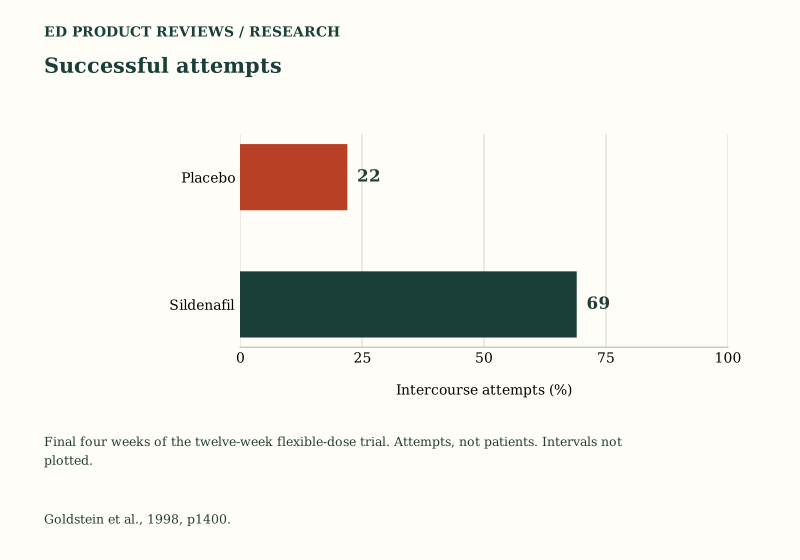
Download chart (PNG) Download data (CSV) Download vector (SVG)
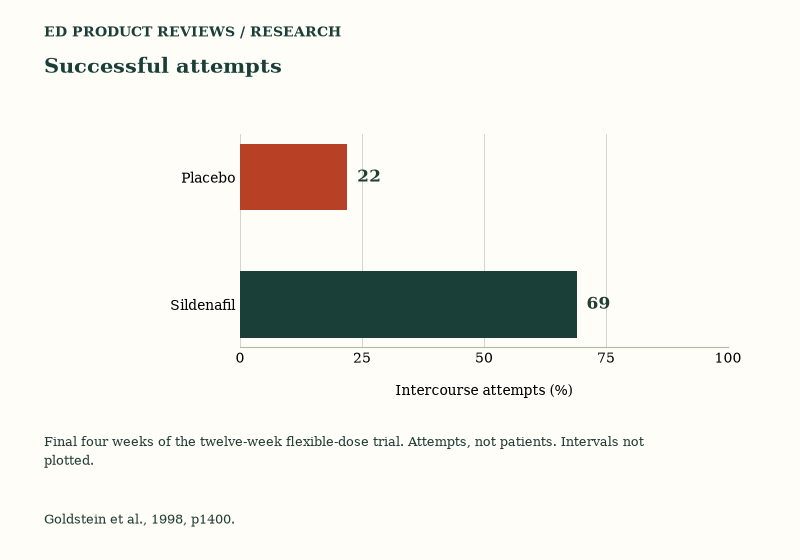
| Group | Percent |
|---|---|
| Placebo | 22 |
| Sildenafil | 69 |
Final four weeks of the twelve-week flexible-dose trial.
Attempts, not patients. Intervals not plotted.
Start with the intervention, before the percentage
Goldstein’s report describes a 24-week fixed-dose study and a separate 12-week flexible-dose study; 329 men were randomized in the latter. That distinction is the first entry in an evidence file. In our reading method, the intervention is a package of features rather than a single word. A result should remain attached to the particular package that generated it.
Imagine a fictional library with three folders called ingredient, formulation and treatment protocol. A medicine name could help locate all three folders, but it would not make their contents identical. The ingredient folder answers what substance is under discussion. The formulation folder specifies the preparation. The protocol folder describes the treatment and measurement rules. Moving a result between folders requires an explanation, not just a matching search term.
This approach also separates two questions that can otherwise become entangled. One asks whether a defined intervention produced a result under study conditions. The other asks whether that result supports a particular present-day product claim. Our guide to approved tablets and compounded medication provides a place to examine the regulatory distinction while keeping this evidence-matching exercise visible.
Count events without turning them into people
The figure’s denominator makes a mathematical difference. Consider a wholly fictional log containing ten attempts. One person records eight attempts, six successful; another records two attempts, neither successful. Six of ten events were successful, giving an event proportion of 60%. One of two people had any successful event, giving a person proportion of 50%. Both calculations describe the invented log, but they answer different questions.
A third calculation would average the two personal success proportions: 75% for the first person and 0% for the second, averaging 37.5%. That gives each person equal weight, while pooling events gives more weight to someone who records more events. These are arithmetic demonstrations, not alternative estimates of the published trial. They show why the words around a percentage are part of the result rather than optional fine print.
When reading a product claim, name the thing counted before considering the size of the number. Then look for the rule that puts observations into the denominator. A person, an event and a questionnaire response are different units. A claim that silently exchanges them changes its meaning even if the printed percentage stays exactly the same.
Keep the observation window on the record
A result also needs a calendar. As an original illustration, imagine a twelve-week fictional experiment in which every week contains ten recorded events. Suppose the first eight weeks contain twenty successful events in total and the last four contain thirty. The last-window result would be 30 divided by 40, or 75%. Across the whole experiment it would be 50 divided by 120, about 41.7%.
Neither number is a correction to the other. They describe different windows in the invented records. If a headline drops the window, the reader cannot tell which question has been answered. The same problem arises when an endpoint measured after a course of treatment is presented as though it were a measurement immediately after the first administration. The missing time description creates an unsupported connection.
For our evidence file, the practical solution is simple: copy the window into the same line as the outcome definition. Keep it there when comparing a paper with a product page, a chart or a summary. Do not reconstruct a whole treatment trajectory from a terminal observation. A complete trajectory would require observations across the relevant periods and a clear account of how those observations were analyzed.
Treat an adjustment rule as part of the intervention
A flexible protocol presents a different interpretation problem from a fixed specification. Consider two hypothetical research plans. In one, the assigned preparation stays fixed. In the other, a defined review process can change it according to recorded response and tolerability. Even if the same ingredient appears in both, the second plan evaluates a treatment strategy that includes those review rules. Its result cannot be described completely by naming one final strength.
This is methodological reasoning about the study distinction, not a recommendation to adjust medication. In an imagined adjustable study, people ending at one strength might differ from those ending at another because earlier response influenced the adjustment. Comparing those final subgroups as though a lottery assigned their final strengths would erase the selection process. The original assignment and the later treatment history must remain separate concepts.
A useful evidence record therefore has room for both the initial treatment assignment and the permitted subsequent decisions. It should also identify who made those decisions and which information was available. For a present-day product, an unanswered question about those features is still an unanswered question; it should not be filled by assuming that a historical research protocol describes the service being reviewed.
Separate formulation evidence from clinical outcomes
FDA states that compounded drugs lack its premarket review for safety, effectiveness and quality. Compounding can address medical needs; contamination or incorrect strength can cause serious harm. These regulatory facts do not supply a clinical result for any named mixture. Our editorial interpretation is that a product file needs distinct spaces for regulatory status, preparation identity and outcome evidence, because no one of those spaces answers all three questions.
Suppose a fictional product description lists the same active ingredient as a study but changes the physical preparation. The immediate task is to document what changed and what evidence addresses that change. A reader should not have to infer an administration route from an illustration or a marketing adjective. The guide to chews, gummies, liquids and tablets offers a separate reading path for those format questions.
The table is an original framework for organizing questions, not a claim that any particular product meets the requirements. It deliberately allows an entry to remain unresolved. That is useful information: an empty field shows where the connection between a study and a product has not yet been documented in the material being examined.
| Record | Question to document | What it does not settle |
|---|---|---|
| Ingredient | What substance or substances are identified? | Whether the finished preparation has matching outcome evidence |
| Preparation | What form and administration route are described? | Whether the treatment protocol matches |
| Outcome record | Which exact intervention generated the result? | Whether that intervention suits an individual reader |
Ask what an added ingredient changes
The Viagra label does not recommend combining it with other PDE5 inhibitors or ED therapies; it identifies possible additional blood-pressure lowering and an absence of established combination safety and efficacy. This is a prescribing boundary, not a catalog of separately tested commercial mixtures. Ingredient counting is therefore an inadequate way to establish either an added benefit or an acceptable risk for a finished preparation.
For an original study-design example, imagine researchers comparing substance A with a preparation containing A plus B. A difference between those groups could address the addition of B under that design. A comparison of A alone with placebo would leave that question unanswered. A comparison of A plus B with placebo would address the combined package but would not, on its own, isolate B’s contribution.
The question becomes more specific as ingredients are added: which contribution is being claimed, against what comparator, and using which outcome? This is why our reading guide to combination products keeps the product description separate from the evidence needed to assess it. A plausible story about how components might complement one another is a research question; it is not the missing comparative observation.
Read uncertainty as a missing dimension of the chart
A bar height communicates an estimate, not the complete evidence supporting it. Our figure intentionally does not plot intervals. Its visual simplicity should not be mistaken for proof that a value is exact or that everyone experienced the same result. An uncertainty assessment would also examine how observations were collected, how incomplete records were handled and what assumptions the analysis used.
As a fictional arithmetic exercise, eight successes among ten events and eighty successes among one hundred events both give 80%. The displayed proportion alone cannot distinguish those records. Nor would the larger event count, by itself, establish how many independent people contributed. Repeated events from the same person introduce another question about the structure of the observations. This example explains why a percentage is insufficient for constructing a patient-level confidence interval.
For a product review, the appropriate response is to retain the reported unit and resist manufacturing extra precision. A neat-looking range calculated from the wrong denominator would be less informative than a clearly labeled estimate. If a proposed comparison needs uncertainty information that has not been established for that comparison, record the requirement explicitly instead of turning the available chart into a more elaborate but unsupported analysis.
Put current safety information beside the identity
The study reported headache, flushing and dyspepsia. Under current Viagra labeling, organic nitrates/nitrites and guanylate-cyclase stimulators, including riociguat, are contraindicated. Cardiovascular status and interacting medicines require assessment. An erection lasting over four hours needs emergency care. A sudden hearing decrease or loss, or abrupt loss of vision, means stop the medicine and seek prompt medical care. Chest pain, dizziness or nausea during sex calls for stopping activity and immediate help.
These are clinical boundaries, rather than variables in a shopping calculation. Our interpretation is that a document comparison should make it easy to take an accurate product description into a professional discussion. It should never encourage a reader to convert a research arm into instructions or use a favorable outcome figure to dismiss a contraindication. A benefit question and a safety question can require different documents.
A useful review also distinguishes an event from a discontinuation. In a hypothetical record, someone might experience an adverse event and continue, or stop for an unrelated reason. Counting only one category would answer a narrower question than counting both. The same distinction matters when a phrase such as tolerability appears in a summary: ask which observations support it, rather than treating it as a universal assurance.
Compare schedules without inventing a contest
Our daily tadalafil trial analysis examines a separate study. That creates an opportunity to compare research questions, not to construct a head-to-head result. If two experiments use different interventions, participant criteria, measurement rules or follow-up windows, lining up their most attractive numbers does not create a shared randomized comparison. The missing common comparison remains missing.
Cialis labeling distinguishes daily from as-needed use and warns that daily exposure matters when assessing interactions. Those distinctions belong in a regimen description. They are not a basis for converting one medicine into another or deciding an individual schedule. Our sildenafil and tadalafil guide is a place to organize the relevant terms while leaving prescribing decisions with a clinician.
An original comparison worksheet can still be useful. Give each study its own column, then label whether each row describes an intervention, an observation or an interpretation. A blank cell is preferable to inserting a number drawn from a different endpoint. The goal is to identify what a future direct comparison would need to measure, rather than declare a winner from experiments that were not designed to settle that contest.
| Feature | What to record for each study | Why keep it separate |
|---|---|---|
| Treatment strategy | Preparation, route and schedule | A shared ingredient does not define the entire intervention |
| Measurement | Outcome unit and observation window | Different units cannot become a common score by relabeling |
| Comparison | The actual assigned comparator | Separate experiments do not create a head-to-head allocation |
Leave a trail from the claim to the source
Pfizer funded the research and contributed design, logistics and analysis support. A source file should retain that relationship beside the methods and results. Funding information does not calculate the size of a bias or decide whether a result is true. It identifies a relationship worth considering when reviewing how a study was planned, analyzed and reported, without replacing the examination of those details.
For the product side of the file, record the exact page, product name, date and the question still needing an answer. Readers can use the Hims Sildenafil review and the Hims Sildenafil Chews review to inspect the documentary records for those names. These links make no claim that either entry reproduces the study intervention or its outcomes; the exercise is to examine what the records actually establish.
Finish by writing a short connection statement in plain language: this observation concerns this intervention, while this product question requires this additional information. A statement that explicit can be corrected when a source changes. It also gives a clinician a more useful starting point than an isolated percentage. The resulting file is a record of reasoning, not a treatment recommendation or a substitute for a prescription.
Questions about the evidence
Can I read the chart as my chance of success?
No individual probability is calculated here. The denominator lesson explains why an event proportion cannot simply become a prediction for one person. A personal assessment asks additional questions about the person and treatment. Keep the result in its original research context and use it to frame a discussion, rather than assign yourself a percentage.
Does a matching ingredient name settle the comparison?
It settles one field in the record. The preparation, route, schedule, comparator and outcome still need examination. In our framework, agreement on one field does not silently fill the others. This is an evidence-matching rule, not a claim that every change produces a clinically meaningful difference.
Is a larger ingredient list evidence of a better product?
Ingredient count does not answer an outcome question. An informative comparison would identify the added contribution being claimed and the study capable of testing it. A mixture’s description and a demonstration of that contribution are different records. Do not use this worksheet to combine medicines or alter prescribed treatment.
Why leave confidence intervals off this figure?
The figure is a compact display of the selected published values. It does not reconstruct a statistical analysis from incomplete denominator information. Inventing an interval would add an unsupported result. The absence of an interval in this display should prompt further source reading, rather than imply that uncertainty is absent.
What would make a product claim easier to evaluate?
An exact formulation description, a clearly identified claim, a matching research reference and an explanation of differences would make the connection inspectable. Our assessment would still distinguish that documentary connection from personal suitability. A reader should be able to follow each step without assuming that a product name resolves an unanswered scientific question.
Editorial assessment
Our editorial assessment is that product-focused reading becomes more useful when it preserves the chain from intervention to measurement to claim. The trial figure is one part of that chain. Its denominator and calendar deserve the same attention as its height. Formulation questions, combination questions and current safety information then occupy their own places in the record. This approach supports a precise conversation about evidence while leaving unresolved questions visible and individual treatment decisions with a qualified clinician.
Research access and limitations
We read the complete original papers available through public exhibits and the cited current labeling and FDA material. We did not inspect trial protocols, supplements or individual participant data. No preparation was purchased, tested or independently assayed. The worked numerical examples are fictional. This review does not establish interchangeability, provider performance or an individual treatment outcome.
Scientific reading
Original sources
Access dates and evidence limits are recorded for each source. Earlier product and guide research retains its original dates.
- Goldstein et al. (1998): oral sildenafil trial
Original primary paper · Checked 2026-10-23
- Understanding the risks of compounded drugs
FDA public information · Checked 2026-10-23
- VIAGRA (sildenafil citrate) US prescribing information
Current prescribing information · Checked 2026-10-23
- Porst et al. (2006): daily tadalafil trial
Original primary paper · Checked 2026-10-23
- Cialis (tadalafil) prescribing information
Current prescribing information · Checked 2026-10-23