A treatment schedule is more than a label placed next to an ingredient. It describes a sequence of administrations across time, with an intended way of assessing the result. When a product is discussed alongside daily tadalafil research, that sequence belongs in the comparison. Looking only at a dose printed on a package would leave the timing and the treatment strategy out of the question.
This article develops a way to read the score changes in the figure and then examine the product connection. The examples use invented numbers to explain arithmetic and research interpretation. They are not additional clinical findings. Our purpose is to make a comparison more exact: identify the intervention, understand the measurement and separate an unanswered product question from an observation the research actually reports.
Study overview
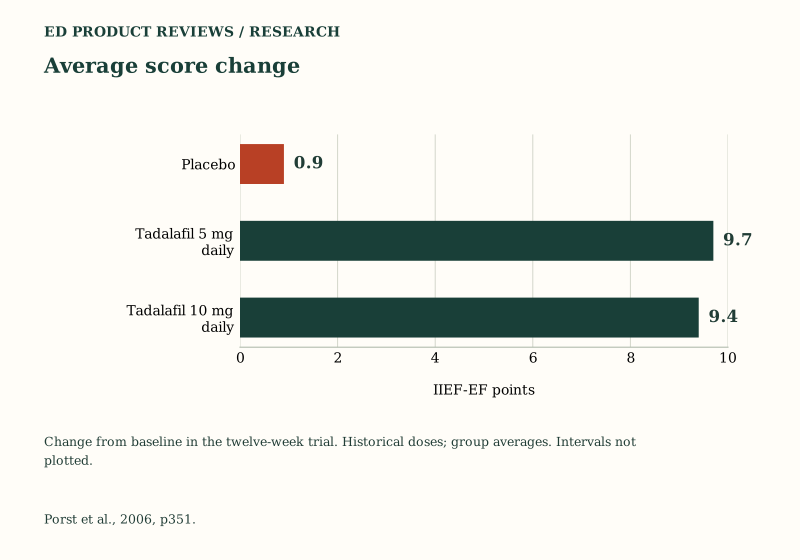
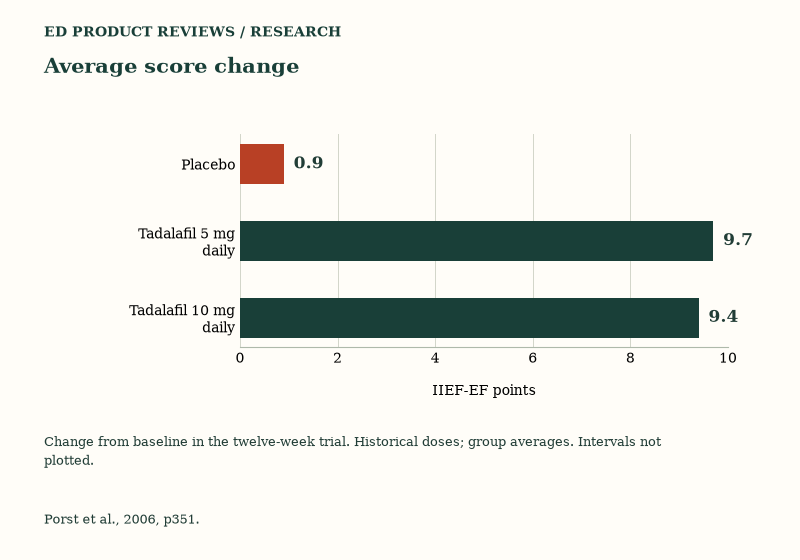
Trial figure and data
Download chart (PNG) Download data (CSV) Download vector (SVG)
| Group | Change |
|---|---|
| Placebo | 0.9 |
| Tadalafil 5 mg daily | 9.7 |
| Tadalafil 10 mg daily | 9.4 |
Change from baseline in the twelve-week trial.
Historical doses; group averages. Intervals not plotted.
Describe the treatment across a calendar
The blinded trial randomized 268 men with ED against placebo. The first reading task is to identify what the assigned intervention includes. For our editorial analysis, a regimen has a preparation, an administration pattern and rules for observation. These features travel together when the result is described. Removing the calendar can turn a treatment strategy into a much less specific ingredient claim.
Consider a fictional comparison between a regularly scheduled intervention and an event-linked intervention. Even if the same substance appears in both descriptions, the question being tested is different. An outcome could reflect the entire assigned strategy, including the opportunity to use it according to its rules. This explanation does not establish an advantage for either pattern; it identifies the comparison that would be needed to investigate one.
A good first note therefore describes the intervention in ordinary language before considering whether it sounds convenient. Convenience is a separate question and would need its own observations. Our guide comparing sildenafil and tadalafil regimens helps organize the vocabulary without assuming that a medicine name, a schedule name and a demonstrated preference are interchangeable descriptions.
A change score needs a starting point
A change is calculated by comparing two values. In an entirely fictional score record, a person starts at 11 and ends at 17, an increase of six points. Another starts at 19 and ends at 25, also an increase of six points. Equal changes do not mean equal final scores. Conversely, two identical final scores can conceal different starting positions and different changes over time.
The unit also matters. Six points on an invented scale are not automatically a 6% improvement. A percentage calculation would need a specified denominator and a justification for interpreting that ratio. For example, six divided by eleven and six divided by nineteen give different percentages, although the point change is identical. Those calculations merely illustrate why replacing points with a percent sign changes the mathematical statement.
When reading the published figure, retain the stated unit instead of making that replacement. Then ask what other information would help interpret a change: the starting distribution, the scale’s structure and the purpose of the measurement. Our argument here is about reading the number accurately. It does not assign a clinical meaning to the invented values or propose a threshold for success in an individual.
Look behind an average without inventing individual results
A mean is formed by adding values and dividing by their number. The fictional sets in the table all have the same mean, yet they describe different patterns. One set gives everyone an equal change. Another puts the entire positive change in a single record. The third combines a negative change with larger positive ones. The mean alone cannot tell a reader which pattern occurred.
This is particularly important when a product explanation replaces a group result with language addressed to the reader. An average does not identify the share of people who improved, the share who reached a particular score or the change one person will experience. Each of those questions would require a suitable definition and the corresponding observations. None can be recovered merely by making the average sound more personal.
The example does not suggest that the real trial followed any of these invented distributions. It shows the information lost when many observations become one summary. That loss of detail is not a reason to discard means; it is a reason to preserve their role. They summarize a group while leaving other useful questions available for separate investigation.
| Invented set | Individual point changes | Mean change |
|---|---|---|
| Equal changes | 4, 4, 4 | 4 points |
| Concentrated change | 0, 0, 12 | 4 points |
| Mixed directions | −2, 4, 10 | 4 points |
Distinguish an analysis endpoint from a completed visit
Efficacy required baseline plus a postbaseline measurement; missing scores used last observation carried forward. That method choice deserves attention when interpreting an endpoint. An endpoint is the value used by an analysis under its rules. It should not be assumed to describe a newly completed measurement at the same final appointment for every participant. The rule determines which observations enter the summary.
Here is a fictional illustration of carrying a measurement forward. A record contains a starting score of 12 and a later score of 18, followed by a missed final measurement. Reusing 18 in the final analysis produces a six-point change for that record. It does not reveal what the unobserved final score would have been. That missing score might have been lower, the same or higher; the example cannot decide.
This distinction makes a follow-up question more precise. Rather than asking whether an endpoint is real or unreal, ask which values were directly observed, which values were assigned by an analysis rule and how conclusions depend on that rule. A reader evaluating another product’s evidence should look for its own handling of missing observations instead of assuming that a familiar headline implies the same analysis.
A shared placebo reference does not rank active arms
A chart with more than one active group invites visual ranking, but the height difference is only the beginning of a comparison. Consider fictional means of 7.2 and 7.5 points. Their difference is 0.3 points. That subtraction does not establish whether the difference is reliably distinguishable from sampling variation, whether it is important to patients or whether the groups satisfy an equivalence criterion.
Those are separate questions with separate requirements. A superiority question would specify the contrast and examine its uncertainty. An equivalence assessment would require a prospectively defined margin and an analysis designed to test differences against that margin. Failing to demonstrate a difference is not, by itself, a demonstration that two interventions are equivalent. The fictional numbers supply none of those missing design decisions.
For this product-focused reading, keep the actual comparator in view and avoid upgrading a visual impression into a treatment choice. Our analysis of sildenafil trial evidence concerns a different research record. Placing results from separate studies next to one another does not assign participants to a new head-to-head experiment, and it does not resolve a comparison the original studies did not make.
Keep historical research and current labeling dated
Current Cialis labeling identifies 2.5 mg and 5 mg for routine daily ED use; the historical 10 mg daily arm is not that current routine labeled regimen. These numbers identify different documentary contexts, not instructions for selecting or changing a prescription. A reader needs to know whether a statement describes a past experiment, current prescribing information or a particular product’s instructions.
An original timeline can help. Place the publication date on the research record, the revision date on the prescribing document and the access date on a product page. These dates describe different events. A newer webpage does not rewrite an older experiment, while an older experiment does not automatically supply current administration advice. The timeline keeps those records related without merging their responsibilities.
The same discipline applies when a product description uses a familiar strength as a shortcut for matching the evidence. A match on that single item leaves the rest of the intervention to examine. Read our guide to approved and compounded ED medication for the regulatory context, then return to the actual prescription and the clinician’s assessment for decisions about personal use.
Identify the preparation before discussing transfer
According to FDA, compounded preparations are not approved by the agency, and their safety, effectiveness and quality do not undergo its premarket review. They can meet medical needs, but poor quality can cause serious harm. This regulatory distinction is relevant to a product file. It does not, on its own, measure the clinical performance of an individual preparation or establish a comparison between two named offers.
For an original evidence exercise, imagine a research record describing preparation A and a product record describing preparation B. List the differences before deciding what evidence would connect them. If the route, ingredient combination or administration instructions differ, the question should name that difference. Saying that both records involve the same ingredient leaves the central connection unexplained; saying they must perform differently would also go beyond the comparison.
Our guide to dosage forms provides a reading path for describing those details. The table below is a question map, not a certification standard or a judgment that any product has passed. Its purpose is to replace a vague request for proof with a more specific request for evidence about the feature that actually changed.
| Feature to identify | Evidence question | Keep this conclusion separate |
|---|---|---|
| Administration route | What evidence addresses the stated route? | Whether the product is convenient to use |
| Ingredient combination | What comparison evaluates the finished combination? | Whether each ingredient has been studied somewhere |
| Treatment schedule | What observations concern that schedule? | Whether a different schedule is personally appropriate |
Evaluate an addition as a defined research question
The Viagra label advises against combining it with other phosphodiesterase-5 (PDE5) inhibitors or ED therapies because combination safety and efficacy have not been established and further blood-pressure lowering is possible. A separate ingredient’s label is not a license to combine treatments. The product question is about the preparation as offered and prescribed, rather than a collection of favorable sentences taken from different documents.
In an original hypothetical design, a researcher wants to learn whether adding component B contributes to treatment A. Comparing A with A plus B could address that contribution under the chosen conditions. Comparing the combination only with an inactive comparator would answer a different question about the package as a whole. Neither design should be described as answering every question about each component.
This logic also helps identify what a claim leaves unspecified. Does it concern a symptom score, an adverse effect, an onset measure or preference? Is the proposed benefit attached to the addition, to the complete product or to a delivery format? Our guide to combination claims encourages that separation. Naming the intended claim precisely makes an evidence request useful without implying that an untested explanation has already been demonstrated.
Read safety alongside, rather than inside, an efficacy average
Nine discontinued for adverse events. That count belongs in a different part of the evidence record from the efficacy mean. It cannot be converted into an arm-specific probability without the relevant allocation and denominator. In an original review framework, events, treatment discontinuations and reasons for discontinuation each deserve their own labels; a single favorable summary does not replace them.
Cialis labeling contraindicates nitrates and guanylate-cyclase stimulators such as riociguat. Cardiovascular health, interacting drugs, kidney or liver disease, alcohol and ongoing daily exposure require clinical review. Seek emergency treatment for an erection exceeding four hours. Sudden vision loss or a sudden hearing reduction or loss requires stopping the medicine and prompt medical attention. If chest pain, dizziness or nausea occurs during sexual activity, stop that activity and get immediate medical help.
These safety directions should remain easy to find even when the surrounding article is focused on statistics. Our editorial interpretation is that a product description is incomplete if it makes the benefit calculation clear while leaving the prescribing context vague. Take an accurate medication and product record to the treating professional. The numerical exercises here do not provide a method for balancing personal risks, combining therapies or adjusting a regimen.
Build a product comparison that can be checked
Lilly ICOS funded it, with company analysis/writing support. This relationship belongs in the reading record, along with the research methods and reported findings. It does not supply a numerical correction factor. Our approach is to keep it visible while evaluating which questions the design answers, which depend on analysis choices and which remain outside the comparison.
For named products, begin with a documented description rather than an assumed connection to the chart. The Ro Daily Tadalafil review and Ro Daily Rise Gummies review are places to inspect the source records associated with those names. Linking to them does not establish current access, a matching study preparation or a reproduced outcome. It offers a route to examine those questions at the product level.
A useful final note separates the observed result from the proposed application in two short sentences. The first identifies the intervention and measurement; the second states what additional information the product comparison requires. That format gives another reader something concrete to verify or challenge. It also makes updates easier: a changed product description can alter the connection without changing what an older trial originally observed.
Questions about the evidence
Does a mean change describe what most participants experienced?
The mean alone cannot answer that. The invented sets above show how equal averages can come from very different patterns. A statement about most participants would need an appropriate definition and a distribution or count that supports it. Do not turn a group average into a frequency claim by changing its wording.
Can a point increase be read as a percentage improvement?
Only after defining and justifying a different calculation. A point change preserves the scale’s stated unit, whereas a percentage needs a denominator. Our fictional starting-score example demonstrates that the two calculations answer different questions. The figure should be read using its printed unit, without replacing that unit with a percent sign.
Does a carried-forward observation prove the final condition stayed unchanged?
No. Reusing an earlier value is an analysis rule, not a later observation. The fictional missed-visit example explains the distinction. To evaluate its importance, examine the amount and reasons for missing information and suitable analyses of uncertainty. This article does not reconstruct unobserved patient records or claim to know their outcomes.
Why not choose whichever active bar is taller?
A numerical ordering does not settle superiority, equivalence or personal suitability. Those questions require the relevant design, statistical comparison and clinical context. Our hypothetical subtraction example keeps the arithmetic visible while identifying what remains unknown. A chart is a way to read a result, not a prescription selector.
What should I ask when a product cites ingredient research?
Ask which exact claim the citation supports, how the studied intervention matches the preparation and which differences remain. A precise answer should identify its evidence rather than rely on a recognizable ingredient name. Take unresolved treatment and safety questions to the prescribing professional; this documentary exercise cannot supply individual medical clearance.
Editorial assessment
Our assessment is that daily-regimen evidence is most useful when the calendar, the measurement and the preparation stay connected. The worked examples explain why an average change is only one part of that record: it does not reveal an individual distribution, fill a missed measurement or establish equivalence between active treatments. A product comparison should then state its proposed connection explicitly and identify the evidence needed for any differences. That produces a more informative discussion than transferring a prominent number from a study directly onto a product name.
Research access and limitations
Full papers were read from public exhibits. Current labeling and FDA material were also examined. Protocols, supplements and individual participant data were not examined. We did not test or assay products, purchase care or evaluate providers’ clinical outcomes. All illustrative scores and study-design examples are fictional. No patient-level predictions or new trial analyses are presented.
Scientific reading
Original sources
Access dates and evidence limits are recorded for each source. Earlier product and guide research retains its original dates.
- Porst et al. (2006): daily tadalafil trial
Original primary paper · Checked 2026-10-23
- Cialis (tadalafil) prescribing information
Current prescribing information · Checked 2026-10-23
- Goldstein et al. (1998): oral sildenafil trial
Original primary paper · Checked 2026-10-23
- Understanding the risks of compounded drugs
FDA public information · Checked 2026-10-23
- VIAGRA (sildenafil citrate) US prescribing information
Current prescribing information · Checked 2026-10-23